
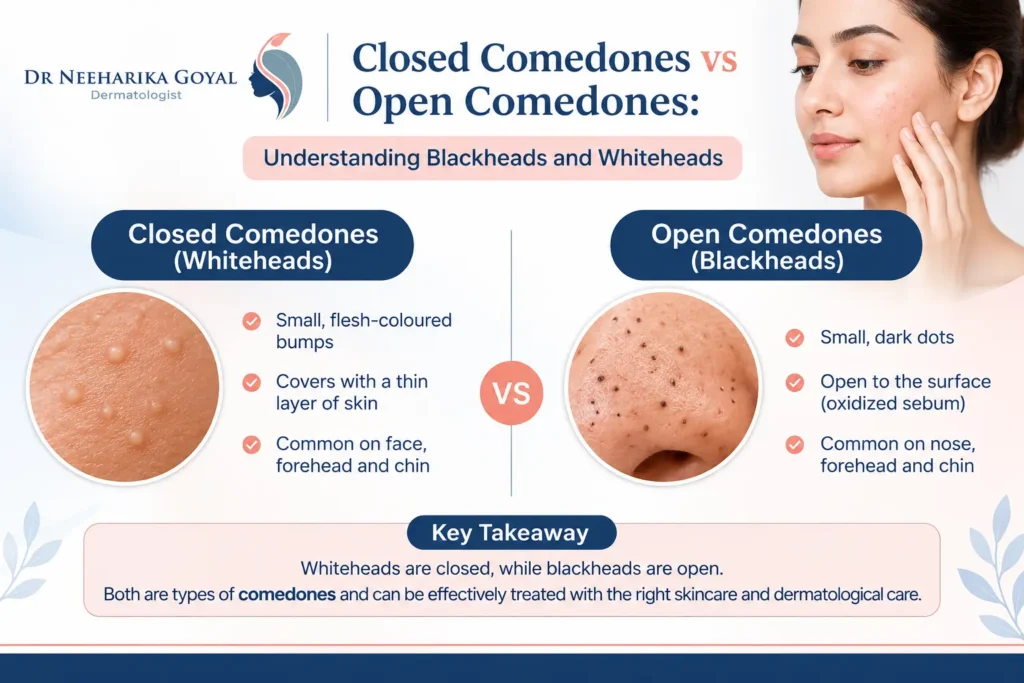
Closed Comedones vs Open Comedones is an important distinction when understanding common types of comedonal acne. Closed comedones, commonly known as whiteheads, and open comedones, known as blackheads, develop when hair follicles become clogged with excess oil and dead skin cells. Although both are forms of non inflammatory acne, they differ in appearance and the structure of the blocked pore.
Comedonal acne can affect teenagers and adults, particularly those with oily or acne prone skin. With appropriate skincare habits and dermatologist recommended treatments, blackheads and whiteheads can often be managed effectively.
What Are Comedones?
Comedones are clogged hair follicles that develop when sebum (natural skin oil) and dead skin cells accumulate inside the pores.
They are considered non inflammatory acne lesions and generally appear as small bumps or spots on the skin.
Comedones are mainly classified into two types:
- Open comedones: Commonly known as blackheads.
- Closed comedones: Commonly known as whiteheads.
Both types are associated with clogged pores, but they differ in appearance and the way the blocked follicle opens onto the skin’s surface.
What Are Closed Comedones (Whiteheads)?
Closed comedones, commonly called whiteheads, develop when a hair follicle becomes blocked with oil and dead skin cells, while its opening remains covered by a thin layer of skin.
Since the clogged material is not exposed to the air, it generally appears white, skin coloured, or slightly raised.
Common Characteristics of Closed Comedones
- Small, raised bumps on the skin.
- Usually white or skin coloured in appearance.
- Often appear on the forehead, cheeks, chin, and jawline.
- May create an uneven or rough skin texture.
- Usually do not cause pain or redness unless inflammation develops.
Whiteheads can be difficult to remove through ordinary cleansing because the blockage remains beneath the skin’s surface.
What Are Open Comedones (Blackheads)?
Open comedones, commonly known as blackheads, develop when a clogged hair follicle remains open at the skin’s surface.
The accumulated oil and dead skin cells are exposed to air. The dark appearance develops due to oxidation and changes in the material within the pore, not because of dirt.
Blackheads commonly appear on the nose, forehead, chin, and other areas with higher oil production.
Common Characteristics of Open Comedones
- Small dark or black spots on the skin.
- Most commonly visible on the nose and chin.
- Usually flat or slightly raised.
- Develop due to accumulated sebum and dead skin cells.
- Generally do not cause pain or significant inflammation.
Blackheads are often mistaken for dirt trapped inside pores. However, excessive washing and scrubbing cannot effectively remove the underlying blockage.
Closed Comedones vs Open Comedones: Key Differences
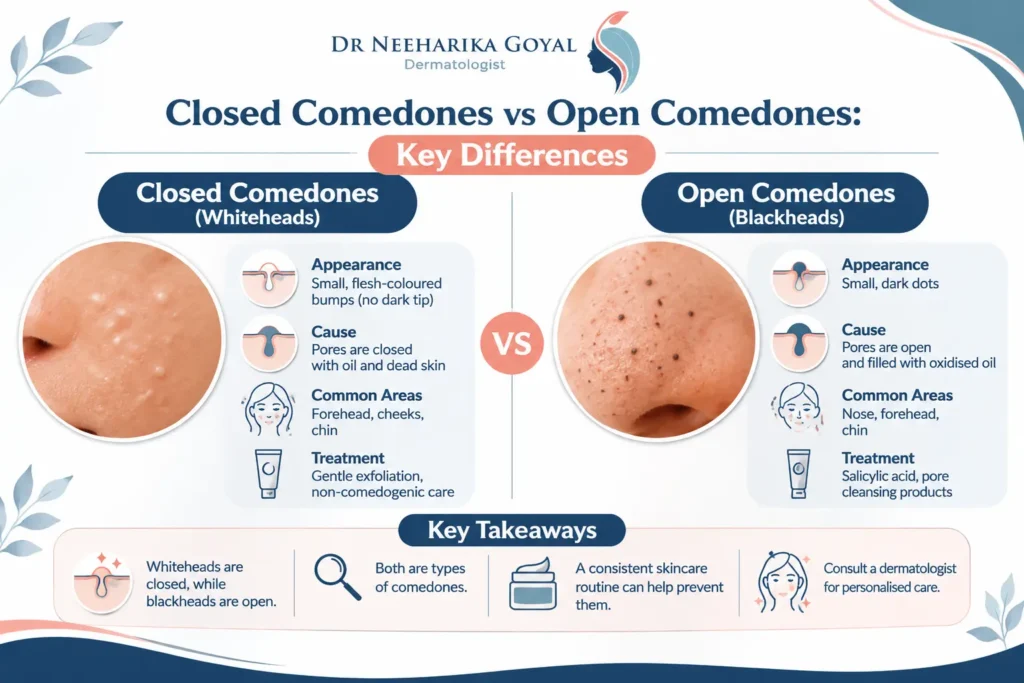
Although both conditions are forms of comedonal acne, their appearance and pore structure are different.
| Feature | Closed Comedones (Whiteheads) | Open Comedones (Blackheads) |
|---|---|---|
| Pore opening | Covered by skin | Open at the surface |
| Appearance | White or skin coloured bumps | Dark or black spots |
| Texture | Small raised bumps | Usually flat or slightly raised |
| Main cause | Blocked follicle with a closed opening | Blocked follicle with an open opening |
| Common locations | Forehead, cheeks, chin | Nose, forehead, chin |
| Visibility | May feel more noticeable than they look | Usually clearly visible |
| Inflammation | Usually non inflammatory | Usually non inflammatory |
Both types can occur simultaneously, and some people experience them alongside inflammatory acne, such as red pimples and pustules.
What Causes Blackheads and Whiteheads?
Several factors can contribute to the development of open and closed comedones.
1. Excess Sebum Production
Sebaceous glands naturally produce oil to protect and lubricate the skin. However, excessive sebum production can increase the likelihood of clogged pores.
People with oily skin may be more prone to blackheads and whiteheads, particularly around the nose, forehead, and chin.
2. Dead Skin Cell Accumulation
The skin naturally sheds dead cells. However, when dead skin cells accumulate inside hair follicles and combine with sebum, they can block the pores.
This may contribute to the formation of both open and closed comedones.
3. Hormonal Fluctuations
Hormonal changes can influence sebum production. Androgens, in particular, can stimulate the sebaceous glands and increase oil production.
Hormonal fluctuations during puberty, menstrual cycles, and certain medical conditions may contribute to comedonal acne.
4. Comedogenic Skincare Products
Some skincare and cosmetic products may contribute to clogged pores, particularly when they are unsuitable for an individual’s skin type.
Heavy creams, certain makeup products, and unsuitable hair products may aggravate existing comedones.
Choosing non comedogenic products can help reduce product related pore blockage.
5. Inconsistent Skincare Habits
Irregular cleansing, improper makeup removal, and frequent changes in skincare products may make it harder to manage acne prone skin.
A simple and consistent skincare routine can help support healthier skin and reduce the likelihood of clogged pores.
6. Genetics and Skin Type
Genetics can influence sebum production, pore characteristics, and an individual’s tendency to develop acne.
People with oily or acne prone skin may be more susceptible to developing blackheads and whiteheads.
How to Treat Closed Comedones and Open Comedones
Treatment depends on the type of comedones, their severity, skin sensitivity, and other acne related concerns.
Several topical treatments can help improve clogged pores and prevent new comedones from developing.
1. Salicylic Acid
Salicylic acid is a beta hydroxy acid (BHA) that helps exfoliate dead skin cells and reduce the accumulation of material inside pores.
It may be particularly useful for people experiencing blackheads and whiteheads.
Regular use of an appropriate formulation can help improve skin texture. However, excessive application may cause dryness and irritation.
2. Topical Retinoids
Topical retinoids, such as adapalene, help regulate skin cell turnover and prevent the formation of clogged pores.
They are commonly recommended for comedonal acne and may help manage both open and closed comedones.
Some people experience initial dryness, redness, or irritation. These products should be introduced according to dermatological advice.
Topical retinoids should generally be avoided during pregnancy.
3. Benzoyl Peroxide
Benzoyl peroxide helps reduce acne associated bacteria and inflammation.
Although it is more commonly used for inflammatory acne, it may be included in a broader acne treatment plan when blackheads and whiteheads occur alongside red pimples.
4. Azelaic Acid
Azelaic acid has anti inflammatory and comedolytic properties. It may help manage certain forms of acne and improve dark marks left behind after breakouts.
It can be considered as part of a treatment routine depending on the individual’s skin condition.
5. Professional Comedone Extraction
In selected cases, a dermatologist may perform professional comedone extraction to remove persistent blackheads and whiteheads.
This procedure should be performed using appropriate techniques and sterile instruments.
Trying to squeeze or extract comedones at home can damage the surrounding skin and increase the risk of inflammation, infection, and scarring.
6. Chemical Peels
Certain chemical peels containing ingredients such as salicylic acid or glycolic acid may help improve clogged pores and uneven skin texture.
A dermatologist can determine whether a chemical peel is suitable based on skin type, acne severity, and sensitivity.
Professional treatments may be used alongside topical skincare rather than as a replacement for an appropriate acne management plan.
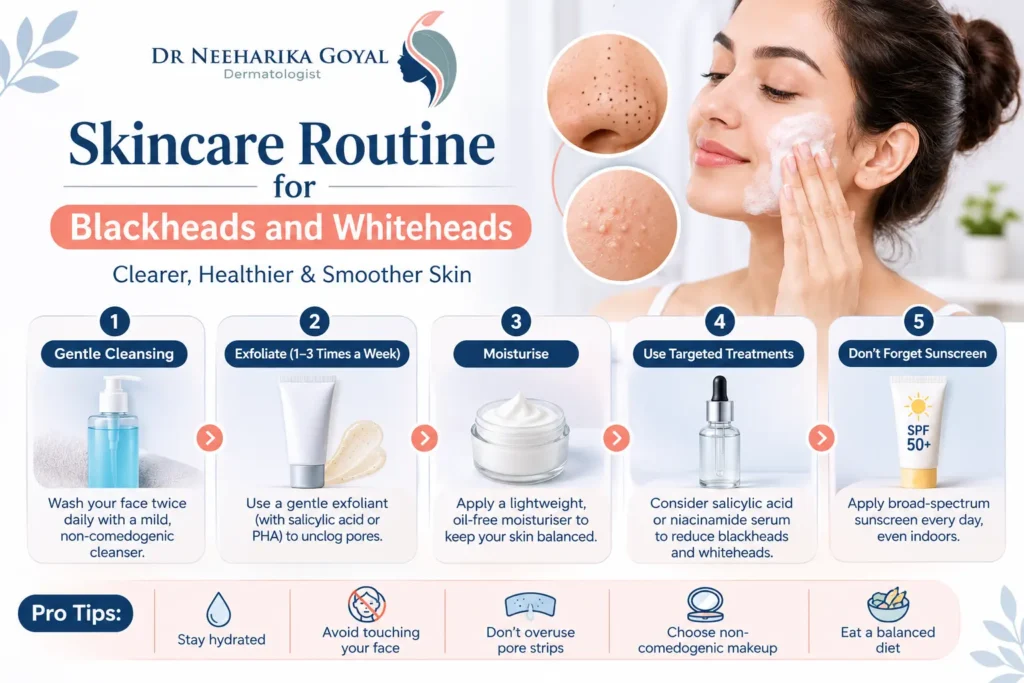
Following a consistent skincare routine can help manage comedonal acne and support overall skin health.
Morning Skincare Routine
1. Gentle Cleanser: Use a mild cleanser to remove excess oil and impurities without stripping the skin.
2. Suitable Treatment: Apply a dermatologist recommended product if required.
3. Lightweight Moisturizer: Choose a non comedogenic moisturizer to maintain skin hydration.
4. Sunscreen: Apply broad spectrum SPF 30 or higher sunscreen to protect the skin from UV damage.
Night Skincare Routine
1. Cleanse Thoroughly: Remove makeup, sunscreen, and accumulated impurities.
2. Apply Acne Treatment: Use prescribed products, such as adapalene or another suitable treatment, according to medical advice.
3. Moisturize: Apply a suitable moisturizer to support the skin barrier and reduce dryness.
Avoid using several exfoliating products together, as excessive exfoliation may irritate the skin and worsen its condition.
Common Mistakes to Avoid When Treating Blackheads and Whiteheads
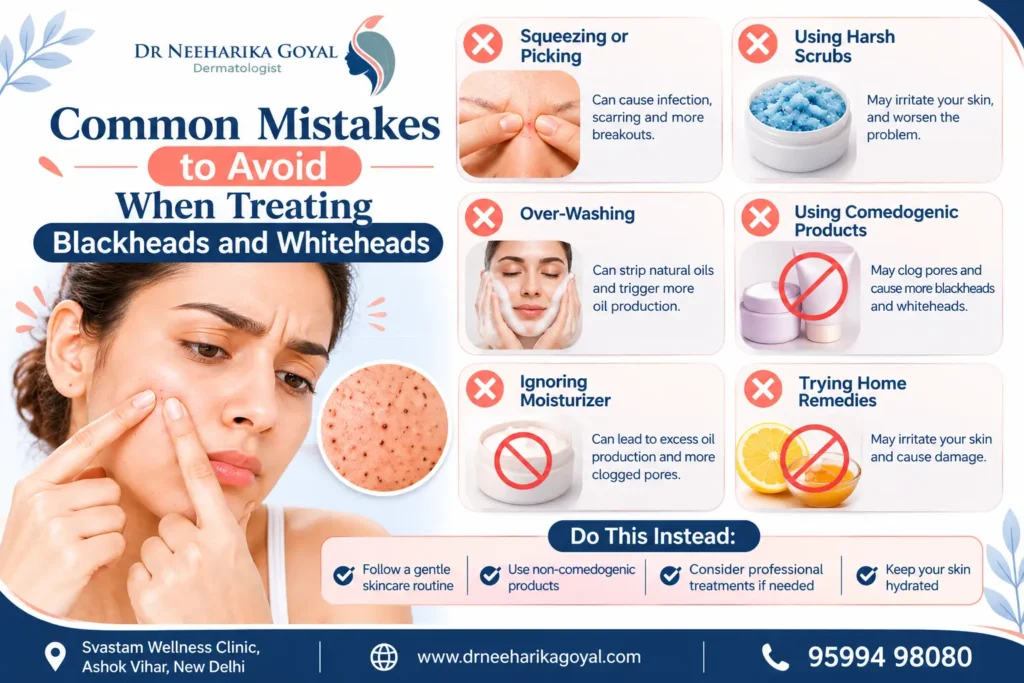
Many people unknowingly follow habits that can worsen clogged pores or irritate acne prone skin.
Here are some common mistakes to avoid:
- Squeezing blackheads and whiteheads: This can damage the skin and increase inflammation.
- Using harsh scrubs: Aggressive scrubbing may irritate the skin without effectively clearing clogged pores.
- Overusing exfoliating acids: Excessive exfoliation can cause dryness, redness, and sensitivity.
- Skipping moisturizer: Oily skin still requires appropriate hydration.
- Using heavy skincare products: Unsuitable formulations may contribute to clogged pores.
- Expecting overnight results: Most acne treatments require consistent use over several weeks.
- Changing products too frequently: Constantly switching products can make it difficult to evaluate treatment effectiveness.
A balanced skincare routine and appropriate treatment are more beneficial than trying multiple products at once.
When Should You Consult a Dermatologist?
Occasional blackheads and whiteheads may improve with suitable skincare, but persistent comedonal acne may require professional treatment.
Consider consulting a dermatologist if:
- Blackheads and whiteheads continue to appear despite regular skincare.
- Small bumps are spreading across the forehead or cheeks.
- Your skin texture remains uneven for a prolonged period.
- Comedones develop into red, painful, or inflamed pimples.
- Over the counter products are causing irritation.
- You are experiencing recurring acne along with dark marks or scars.
A dermatologist can assess your skin, identify the type of acne, and recommend suitable treatment options based on your individual needs.
Conclusion
Closed comedones and open comedones are two common forms of non inflammatory acne. While whiteheads develop when clogged pores remain covered by skin, blackheads form when the blocked pore remains open and its contents are exposed to air.
Understanding these differences can help you select appropriate skincare products and avoid common mistakes such as excessive scrubbing and squeezing pimples.
Ingredients such as salicylic acid, topical retinoids, and selected professional treatments can help manage comedonal acne. However, persistent or worsening breakouts may require a dermatologist’s assessment.
Frequently Asked Questions
1. Are closed comedones the same as whiteheads?
Yes. Closed comedones are commonly called whiteheads. They develop when oil and dead skin cells block a hair follicle whose opening remains covered by skin.
2. Are open comedones the same as blackheads?
Yes. Open comedones are commonly known as blackheads. Their dark appearance develops when material inside an open clogged pore is exposed to air.
3. Why do blackheads look black?
Blackheads appear dark because of oxidation and changes in the material inside the open pore. They are not simply caused by dirt.
4. Can closed comedones turn into pimples?
Yes. Closed comedones may become inflamed and develop into inflammatory acne lesions when inflammation occurs around the blocked follicle.
5. Which ingredient is best for blackheads and whiteheads?
Salicylic acid and topical retinoids are commonly used for comedonal acne. The appropriate choice depends on skin type, severity, and individual tolerance.
About Dr. Neeharika Goyal
Dr. Neeharika Goyal is a Consultant Dermatologist at Svastam Wellness Clinic, Ashok Vihar, New Delhi. She provides personalized dermatological care for concerns such as acne, blackheads, whiteheads, pigmentation, acne scars, and other skin conditions.
With an emphasis on understanding individual skin concerns and recommending suitable treatment options, patients receive guidance based on their skin type and dermatological needs.
If blackheads, whiteheads, or recurring clogged pores are affecting your skin, a dermatological consultation can help you understand your skin better and choose an appropriate treatment approach.